
Claude Code v2.1.88 accidentally exposed 510K lines. The 5 hidden features: Kairos (permanent memory), Undercover Mode (stealth), Ultraplan (deep planning), Pet System (Buddy), Multi-Agent. Source-cited.
Read More
Strong, eventual, causal, read-your-writes, linearizable — consistency models are taught as a taxonomy. Production uses them as a menu. Ten scenarios, the right consistency choice for each, and the engineering that makes the choice work.
Read More
A first-principles breakdown of the entire AI stack — from LLM to Agent in one mental model. An LLM can only output text. Everything else is the program.
Read More
gRPC interceptors are where cross-cutting concerns live — auth, tracing, retry, metrics, rate limiting. Most examples online show toy single-interceptor demos. Production systems need to stack, order, and compose them correctly. A practical guide.
Read More
Go 1.18 shipped generics in March 2022. Four years later, the honest picture: they're useful for a narrower set of problems than the community hoped, they fit naturally in a few places, and overuse them and your code gets worse. A production retrospective.
Read More
Most performance advice for Go is ritual — 'use sync.Pool,' 'avoid interface boxing,' 'preallocate slices.' Useful sometimes, hollow often. A production engineer's guide to profiling Go systems with pprof, reading escape analysis output, and understanding when the compiler actually inlines.
Read More
A working guide to Go's sync.Pool (golang sync pool): what it actually does, when pooling per-request buffers saves GC pressure, when it is wasted effort, the Reset trap, and the alloc benchmark that tells the difference.
Read More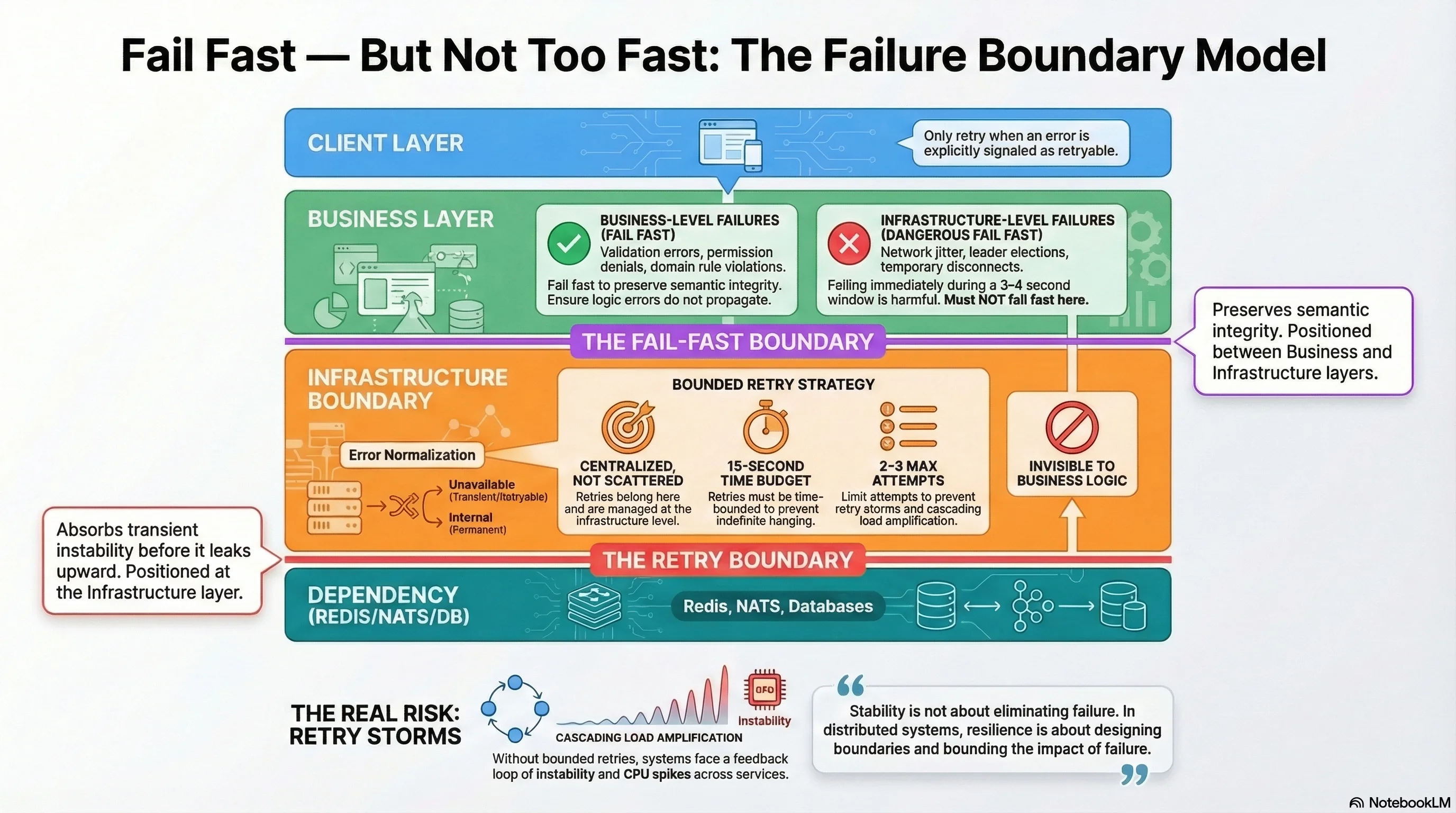
Why blind fail-fast during leader election causes retry storms, and how bounded retry budgets, failure boundaries, and error normalization create predictable distributed systems.
Read More
The most common microservices mistake isn't picking the wrong transport. It's misreading who is responsible for knowing the work finished. A field guide to completion ownership in RPC, message bus, and event-driven systems.
Read More
All three are 'messaging systems.' None of them is interchangeable with the others. A practical breakdown of NATS, Kafka, and MQTT — by the actual design axes that determine which one breaks when you misuse it.
Read More